
Trim controls include trim tabs, servo tabs, balance tabs, and spring tabs, all of which help reduce pilot workload and improve aircraft handling characteristics. These devices assist in maintaining a desired flight attitude by relieving control pressures on the primary flight controls.
Trim tabs are small, adjustable airfoils recessed into the trailing edges of the primary control surfaces. [Figure 1]
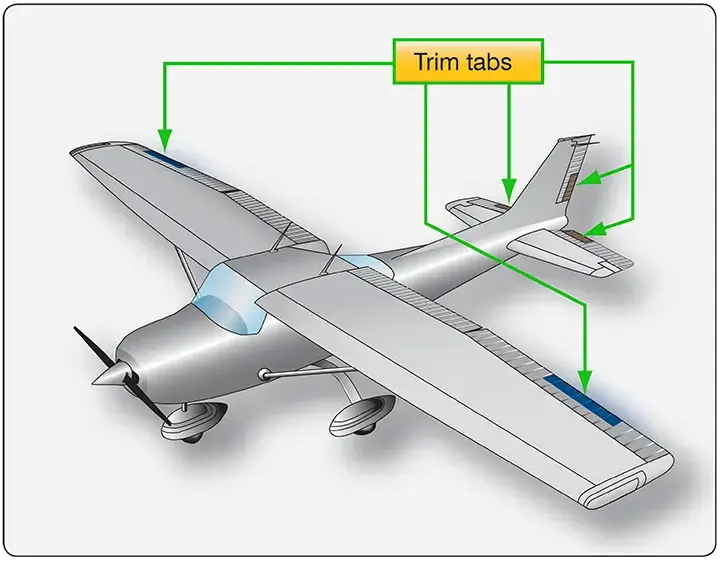 |
| Figure 1. Trim tabs |
When deflected, a trim tab alters the airflow over the parent control surface, producing an aerodynamic force that moves or holds the primary control surface in a trimmed position. Trim tabs are used to correct any persistent tendency of the aircraft to pitch, roll, or yaw away from the desired attitude. Their primary purpose is to allow the pilot to eliminate unbalanced control forces during flight, enabling hands-off or reduced-effort control without continuous pressure on the primary controls.
Servo tabs, sometimes referred to as flight tabs, are commonly installed on large or heavily loaded control surfaces. These tabs move in response to pilot input and, through aerodynamic force, assist in moving the main control surface in the desired direction. In this system, only the servo tab is directly actuated by the pilot’s control input, while the primary control surface moves as a result of the aerodynamic force generated by the tab. Servo tabs significantly reduce control forces, especially at higher airspeeds.
Balance tabs are designed to move in the opposite direction of the primary flight control surface. As the tab deflects, aerodynamic forces acting on it help reduce the hinge moment of the main control surface, thereby assisting the pilot in moving the control. Balance tabs are effective in decreasing control forces while maintaining conventional control system operation.
Spring tabs resemble trim tabs in appearance but serve a different function. Rather than trimming the aircraft, spring tabs assist the pilot in moving the primary control surface, particularly at high airspeeds. They operate through a spring mechanism that allows the tab to deflect only when aerodynamic loads on the primary control become sufficiently high. In this way, spring tabs perform a function similar to hydraulic boost systems by reducing pilot effort.
[Figure 2] illustrates how each type of trim or auxiliary tab is hinged to its respective primary control surface and operated through an independent control mechanism. These tab systems play a critical role in ensuring controllability, reducing pilot fatigue, and enhancing overall flight safety.
 |
| Figure 2. Types of trim tabs |