
Composite aircraft structures require specialized fastening systems that provide high strength while minimizing damage to the laminate. Unlike conventional metal structures, composite laminates are sensitive to bearing loads, galvanic corrosion, and delamination around fastener holes. For this reason, aircraft manufacturers use specially designed fasteners, blind fastening systems, and corrosion-compatible materials to ensure structural integrity and long-term durability.
Many manufacturers produce specialty fasteners for composite structures, and several types are commonly used, including threaded fasteners, lockbolts, blind bolts, blind rivets, and specialty fasteners for soft structures such as honeycomb panels. The primary differences between fasteners used in metal and composite structures are the fastener materials and the footprint diameters of nuts and collars.
Corrosion Precautions
Neither fiberglass nor Kevlar® fiber-reinforced composites cause corrosion problems when used with most fastener materials. Composites reinforced with carbon fibers, however, are quite cathodic when used with materials, such as aluminum or cadmium, the latter of which is a common plating used on fasteners for corrosion protection.
Fastener Materials
Titanium alloy Ti-6Al-4V is the most common alloy for fasteners used with carbon fiber reinforced composite structures. Austenitic stainless steels, superalloys (e.g., A286), multiphase alloys (e.g., MP35N or MP159), and nickel alloys (e.g., alloy 718) also appear to be very compatible with carbon fiber composites.
Fastener System for Sandwich Honeycomb Structures (SPS Technologies Comp Tite)
The adjustable sustain preload (ASP) fastening system provides a simplified method of fastening composite, soft-core, metallic, or other materials, which are sensitive to fastener clamp-up or installation force conditions. The clamping force can be infinitely adjusted within maximum recommended torque limits and no further load is applied during installation of the lock collar. The fastener is available in two types. The ASP® has a full shank and the 2ASP® has a pilot-type shank. [Figures 1 and 2]
 |
| Figure 1. ASP fastener system |
 |
| Figure 2. ASP fastener system installation sequence |
Hi-Lok® and Huck-Spin® Lockbolt Fasteners
Most composite primary structures for the aircraft industry are fastened with Hi-Loks® (Hi-Shear Corp.) or Huck-Spin® lockbolts for permanent installations. The Hi-Lok® is a threaded fastener that incorporates a hex key in the threaded end to react to the torque applied to the collar during installation. The collar includes a frangible portion that separates at a predetermined torque value. [Figure 3]
 |
| Figure 3. Hi-Lok® installation |
The lockbolt incorporates a collar that is swaged into annular grooves. It comes in two types: pull and stump. The pull-type is the most common, where a frangible pintail is used to react the axial load during the swaging of the collar. When the swaging load reaches a predetermined limit, the pintail breaks away at the breakneck groove.
The installation of the Hi-Lok® and the pull-type Huck-Spin® lockbolt can be performed by one technician from one side of the structure. The stump-type lockbolt, on the other hand, requires support on the head side of the fastener to react the swage operation. This method is usually reserved for automated assembly of detailed structures in which access is not a problem.
The specific differences in these fasteners for composite structures in contrast to metal structures are small. For the Hi-Lok®, material compatibility is the only issue; aluminum collars are not recommended. Standard collars of A286, 303 stainless steel, and titanium alloy are normally used.
The Huck-Spin® lockbolt requires a hat-shaped collar that incorporates a flange to spread the high bearing loads during installation. The lockbolt pin designed for use in composite structures has six annular grooves as opposed to five for metal structure. [Figures 4 and 5]
 |
| Figure 4. Huck-Spin® lockbolt |
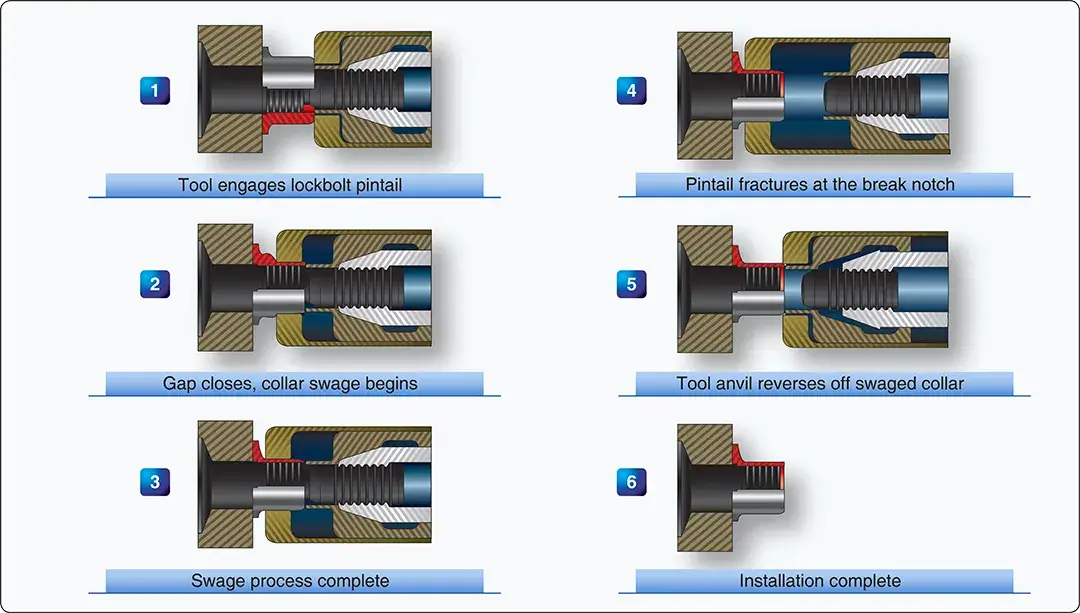 |
| Figure 5. Huck-Spin® installation sequence |
Eddie-Bolt® Fasteners
Eddie-Bolt® fasteners (Alcoa) are similar in design to Hi-Loks® and are a natural choice for carbon fiber composite structures. The Eddie-Bolt® pin is designed with flutes in the threaded portion, which allow a positive lock to be made during installation using a specially designed mating nut or collar. The mating nut has three lobes that serve as driving ribs.
During installation, at a predetermined preload, the lobes compress the nut material into the flutes of the pin and form the locking feature. The advantage for composite structures is that titanium alloy nuts can be used for compatibility and weight saving without the fear of galling. The nuts spin on freely, and the locking feature is established at the end of the installation cycle. [Figure 6]
 |
| Figure 6. Eddie-Bolts® |
Cherry’s E-Z Buck® (CSR90433) Hollow Rivet
The Cherry Hollow End E-Z Buck® rivet is made from titanium/columbium alloy and has a shear strength of 40 KSI. The E-Z Buck® rivet is designed to be used in a double flush application for fuel tanks. The main advantage of this type of rivet is that it takes less than half the force of a solid rivet of the same material. The rivets are installed with automated riveting equipment or a rivet squeezer. Special optional dies ensure that the squeezer is always centered during installation, avoiding damage to the structure. [Figure 7]
 |
| Figure 7. Cherry’s E-Z Buck hollow rivet |
Blind Fasteners
Composite structures do not require as many fasteners as metal aircraft because stiffeners and doublers are co-cured with the skins, eliminating many fasteners. Composite aircraft structures often use larger panels, which can limit backside access. Therefore, blind fasteners or screws and nutplates must be used in these areas. Many manufacturers make blind fasteners for composite structures; a few are discussed below.
Blind Bolts
The Cherry Maxibolt® is available in titanium for compatibility with composite structures. The shear strength of the Maxibolt® is 95 KSI. It can be installed from one side with a G-83 or equivalent pneumatic-hydraulic installation tool, and is available in 100° flush head, 130° flush head, and protruding head styles. [Figure 8]
 |
| Figure 8. Cherry’s titanium Maxibolt |
The Alcoa UAB™ blind bolt system is designed for composite structures and is available in titanium and stainless steel. The UAB™ blind bolt system is available in 100° flush head, 130° flush head, and protruding head styles.
The Accu-Lok™ Blind Fastening System is designed specifically for use in composite structures in which access is limited to one side of the structure. It combines high joint preload with a large diameter footprint on the blind side.
The large footprint enables distribution of the joint preload over a larger area, virtually eliminating the possibility of delaminating the composite structure. The shear strength of the Accu-Lok™ is 95 KSI, and it is available in 100° flush head, 130° flush head, and protruding head styles. A similar fastener designed by Monogram is called the Radial-Lok®. [Figure 9]
 |
| Figure 9. Accu-Lok ™ installation |
Fiberlite
The fiberlite fastening system uses composite materials for a wide range of aerospace hardware. Fiberlite fasteners provide strength equivalent to aluminum at approximately two-thirds the weight. The composite fastener provides good material compatibility with carbon fiber and fiberglass.
Screws and Nutplates in Composite Structures
The use of screws and nutplates in place of Hi-Loks® or blind fasteners is recommended if a panel must be removed periodically for maintenance. Nutplates used in composite structures usually require three holes: two for attachment of the nutplate and one for the removable screw, although rivetless nutplates and adhesive bonded nutplates are available that do not require drilling and countersinking two extra holes.
Quick Review: Composite Structures Fasteners
Why is aluminum prohibited for fasteners used in carbon fiber structures?
How do Huck-Spin lockbolts for composite assemblies differ from those used in metal?
- Hat-Shaped Collar: Incorporates an integrated wide flange designed to spread the high swaging and bearing loads across a larger surface area to prevent crushing the plies.
- Annular Grooves: The fastener pin features six annular locking grooves instead of the five typical for metal components, tailoring the load distribution.
What is the benefit of the Eddie-Bolt system in carbon fiber installations?
How do specialized blind bolts like the Accu-Lok prevent composite delamination?
RELATED POSTS