
Since turbine engine ignition systems normally operate only during the engine-starting cycle, they are generally more reliable and require less maintenance than reciprocating engine ignition systems. Unlike reciprocating engine ignition systems, turbine engine ignition systems do not require ignition timing to occur at a precise point in the engine operating cycle.
The system is used to ignite the fuel in the combustor and is then switched off. Other modes of turbine ignition system operation, such as continuous ignition that is used at a lower voltage and energy level, are used for certain flight conditions.
Continuous ignition is used in case the engine flames out. The system can relight the fuel-air mixture before the engine loses sufficient rotational speed to prevent a successful restart. Examples of critical flight modes that use continuous ignition are takeoff, landing, and some abnormal and emergency situations.
Most gas turbine engines are equipped with a high-energy, capacitor-type ignition system and are air cooled by fan airflow. Fan air is ducted to the exciter box, and then flows around the igniter lead and surrounds the igniter before flowing back into the nacelle area. Cooling is especially important when continuous ignition is used for extended periods. Gas turbine engines may be equipped with an electronic-type ignition system, which is a variation of the simpler capacitor-type system.
The typical turbine engine is equipped with a capacitor-type, or capacitor discharge, ignition system consisting of two identical independent ignition units operating from a common low-voltage (DC) electrical power source: the aircraft battery, 115 VAC, or its permanent magnet generator. The generator is turned directly by the engine through the accessory gearbox and produces power any time the engine is turning.
The fuel in turbine engines can be ignited readily in ideal atmospheric conditions, but since they often operate in the low temperatures of high altitudes, it is imperative that the system be capable of supplying a high heat intensity spark. Thus, a high voltage is supplied to arc across a wide igniter spark gap, providing the ignition system with a high degree of reliability under widely varying conditions of altitude, atmospheric pressure, temperature, fuel vaporization, and input voltage.
A typical ignition system includes two exciter units, two transformers, two intermediate ignition leads, and two high-tension leads. Thus, as a safety factor, the ignition system is actually a dual system designed to fire two igniter plugs. [Figure 1]
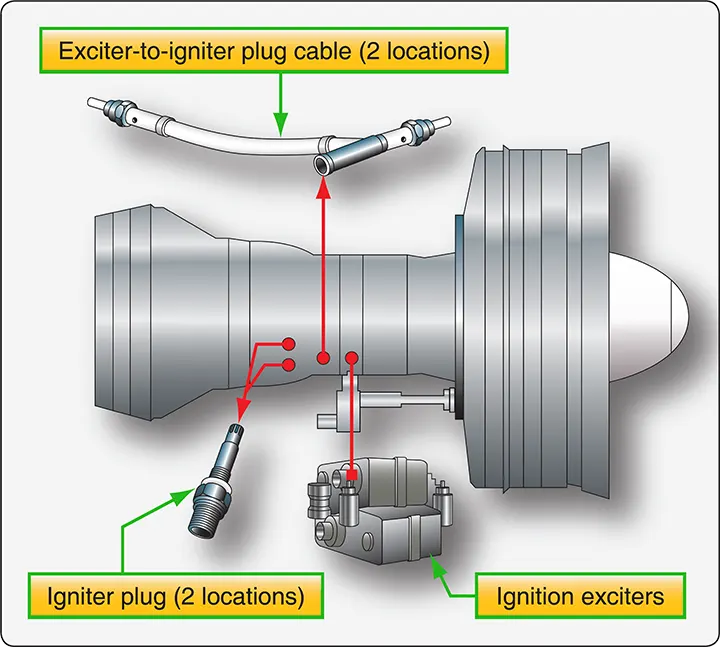
Figure 2 shows a functional schematic of a typical older-style capacitor-discharge ignition system.

A 24-volt DC input voltage is supplied to the input receptacle of the exciter unit. Before the electrical energy reaches the exciter unit, it passes through a filter that prevents noise voltage from being induced into the aircraft electrical system. The low-voltage input power operates a DC motor that drives one multilobe cam and one single-lobe cam. At the same time, input power is supplied to a set of breaker points that are actuated by the multilobe cam.
From the breaker points, a rapidly interrupted current is delivered to an auto transformer. When the breaker points close, the flow of current through the primary winding of the transformer establishes a magnetic field. When the breaker points open, the flow of current stops, and the collapse of the field induces a voltage in the secondary of the transformer.
This voltage causes a pulse of current to flow into the storage capacitor through the rectifier, which limits the flow to a single direction. With repeated pulses, the storage capacitor accumulates a charge of up to approximately 4 joules. The storage capacitor is connected to the spark igniter through the triggering transformer and a contactor, normally open.
When the charge on the capacitor has built up, the contactor is closed by the mechanical action of the single-lobe cam. A portion of the charge flows through the primary of the triggering transformer and the capacitor connected with it. This current induces a high voltage in the secondary, which ionizes the gap at the spark igniter.
When the spark igniter is made conductive, the storage capacitor discharges the remainder of its accumulated energy along with the charge from the capacitor in series with the primary of the triggering transformer. The spark rate varies in proportion to the DC supply voltage, which affects motor speed.
However, since both cams are geared to the same shaft, the storage capacitor always accumulates the same amount of stored energy from the same number of pulses before discharge. The employment of the high-frequency triggering transformer, with a low-reactance secondary winding, holds the time duration of the discharge to a minimum. This concentration of maximum energy in minimum time achieves an optimum spark for ignition purposes, capable of removing carbon deposits and vaporizing globules of fuel.
All high voltage in the triggering circuits is completely isolated from the primary circuits. The complete exciter is hermetically sealed, protecting all components from adverse operating conditions, eliminating the possibility of flashover at high altitude caused by reduced air pressure. This also ensures shielding against leakage of high-frequency voltage interfering with the radio reception of the aircraft.
Capacitor Discharge Exciter Unit
This capacitor-type system provides ignition for turbine engines. Like other turbine ignition systems, it is required only for starting the engine; once combustion has begun, the flame is continuous. [Figure 3]
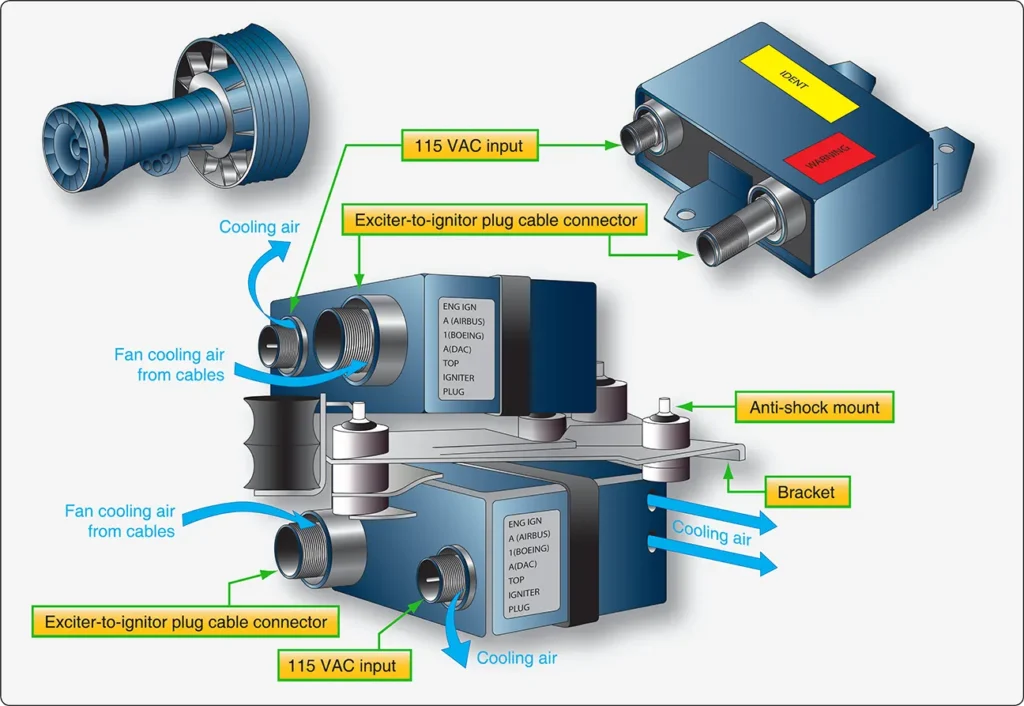
The energy is stored in capacitors. Each discharge circuit incorporates two storage capacitors; both are located in the exciter unit. The voltage across these capacitors is stepped up by transformer units.
At the instant of igniter plug firing, the resistance of the gap is lowered sufficiently to permit the larger capacitor to discharge across the gap. The discharge of the second capacitor is at low voltage but very high energy. The result is a spark of great heat intensity, capable of not only igniting abnormal fuel mixtures but also burning away any foreign deposits on the plug electrodes.
The exciter is a dual unit that produces sparks at each of the two igniter plugs. A continuous series of sparks is produced until the engine starts. The power is then cut off, and the plugs do not fire while the engine is operating, except when continuous ignition is selected for specific flight conditions. This is why the exciters are air cooled to prevent overheating during long use of continuous ignition.
Igniter Plugs
The igniter plug of a turbine engine ignition system differs considerably from the spark plug of a reciprocating engine ignition system. [Figure 4]
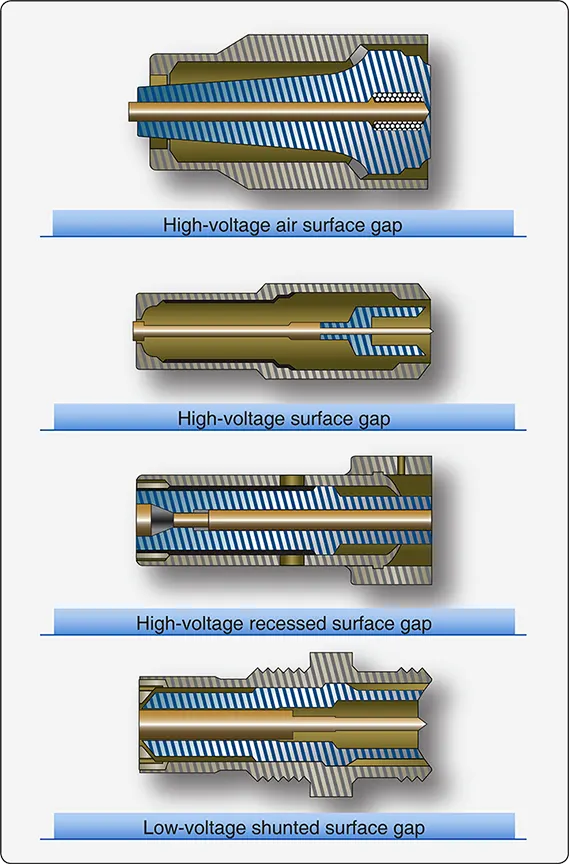
Its electrode must be capable of withstanding a current of much higher energy than the electrode of a conventional reciprocating-engine spark plug. This high-energy current can quickly cause electrode erosion, but the short periods of operation minimize this aspect of igniter maintenance.
The electrode gap of the typical igniter plug is designed much larger than that of a spark plug since the operating pressures are much lower and the spark can bridge the gap more easily than in a spark plug. Finally, electrode fouling, common to the spark plug, is minimized by the heat of the high-intensity spark.
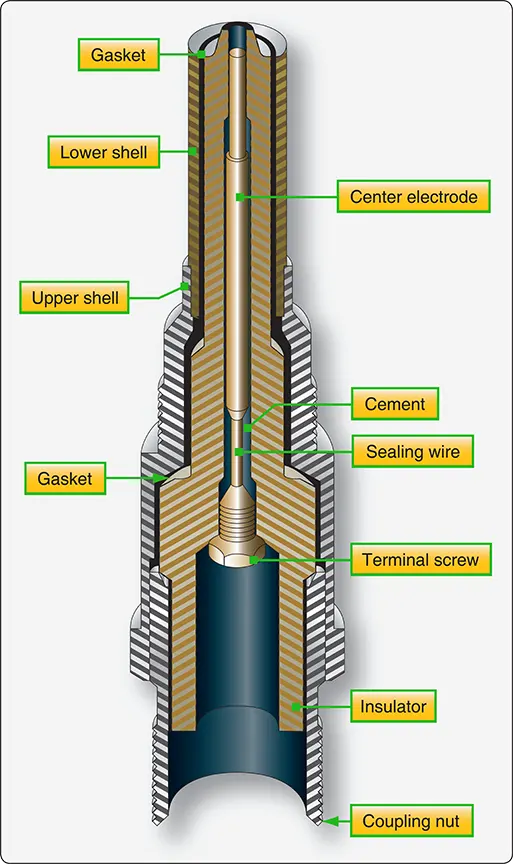
Figure 5 is a cutaway illustration of a typical annular-gap igniter plug, sometimes referred to as a long-reach igniter because it projects slightly into the combustion chamber liner to produce a more effective spark.
Another type of igniter plug, the constrained-gap plug, is used in some types of turbine engines. [Figure 6]

It operates at a much cooler temperature because it does not project into the combustion chamber liner. This is possible because the spark does not remain close to the plug, but arcs beyond the face of the combustion chamber liner.