
All powered aircraft require fuel on board to operate the engine(s). A fuel system consisting of storage tanks, pumps, filters, valves, fuel lines, metering devices, and monitoring devices is designed and certified under strict Title 14 Code of Federal Regulations (14 CFR) requirements. Each system must provide an uninterrupted flow of contaminant-free fuel regardless of the aircraft’s attitude. Since fuel load can be a significant portion of the aircraft’s weight, the airframe must be designed with sufficient structural strength. Varying fuel loads and shifts in weight during maneuvers must not negatively affect control of the aircraft in flight.
Each Federal Aviation Administration (FAA) certified aircraft is designed and constructed under regulations applicable to that type of aircraft. The certification airworthiness standards are found in 14 CFR as follows:
- 14 CFR part 23—Airworthiness Standards: Normal Category Airplanes
- 14 CFR part 25—Airworthiness Standards: Transport Category Airplanes
- 14 CFR part 27—Airworthiness Standards: Normal Category Rotorcraft
- 14 CFR part 29—Airworthiness Standards: Transport Category Rotorcraft
- 14 CFR part 31—Airworthiness Standards: Manned Free Balloons
Additional information is found in 14 CFR part 33. It addresses airworthiness standards for engines and pertains mainly to engine fuel filter and intake requirements.
Title 14 CFR part 23, Airworthiness Standards: Normal Category Airplanes, § 23.2430, Fuel Systems, is summarized below. Airworthiness standards specified for air carrier and helicopter certification are similar. Although the technician is rarely involved with designing fuel systems, a review of these criteria gives insight into how an aircraft fuel system operates.
Each fuel system must be constructed and arranged to ensure fuel flow at a rate and pressure established for proper engine and auxiliary power unit (APU) functioning under each likely operating condition. This includes any maneuver for which certification is requested and during which the engine or APU is operating. [Figure 1]
 |
| Figure 1. Aircraft fuel systems must deliver fuel during any maneuver for which the aircraft is certified |
Each fuel system must be arranged so that no fuel pump can draw fuel from more than one tank at a time. There must also be a means to prevent the introduction of air into the system.
Each fuel system for a turbine engine powered airplane must meet applicable fuel venting requirements. 14 CFR part 34 outlines requirements that fall under the jurisdiction of the Environmental Protection Agency (EPA). A turbine engine fuel system must be capable of sustained operation throughout its flow and pressure range even though the fuel has some water in it. The standard requires that the engine continue to operate using fuel initially saturated with water at 80 °F having 0.75 cubic centimeter (cm³) of free water per gallon added to it and then cooled to the most critical condition for icing likely to be encountered in operation.
Fuel System Independence
Each fuel system must be designed and arranged to provide independence between multiple fuel storage and supply systems so that failure of any one component in one system will not result in loss of fuel storage or supply of another system.
Fuel System Lightning Protection
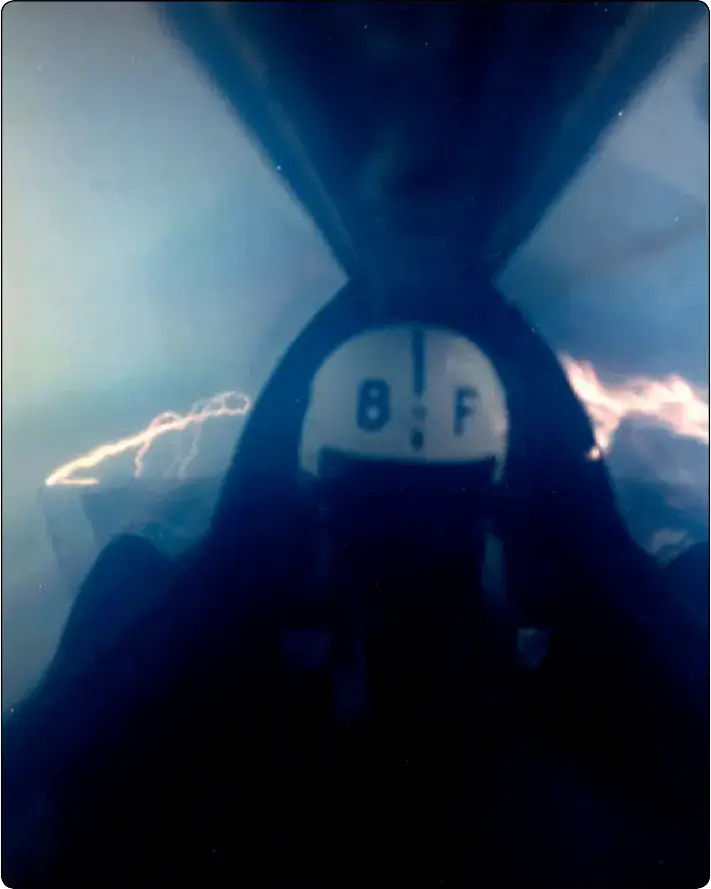
The fuel system must be designed and arranged to prevent the ignition of the fuel within the system by direct lightning strikes or swept lightning strokes to areas where such occurrences are highly probable, or by corona or streamering at fuel vent outlets. A corona is a luminous discharge that occurs as a result of an electrical potential difference between the aircraft and the surrounding area. Streamering is a branch-like ionized path that occurs in the presence of a direct stroke or under conditions in which lightning strikes are imminent. [Figure 2]
 |
| Figure 2. Lightning streamering at the wingtips of a jet fighter |
Fuel Flow
The fuel system must be capable of providing the fuel necessary to ensure that each powerplant and auxiliary power unit functions properly under all likely operating conditions. It must also prevent hazardous contamination of the fuel supplied to each powerplant and auxiliary power unit.
The fuel system must provide the flightcrew with a means to determine the total usable fuel available and provide an uninterrupted supply of that fuel when the system is correctly operated, accounting for likely fuel fluctuations. It should also provide a means to safely remove or isolate the fuel stored in the system from the airplane and be designed to retain fuel under all likely operating conditions and minimize hazards to the occupants during any survivable emergency landing. For level 4 airplanes, as defined under part 23 certification categories, failure due to overload of the landing system must be taken into account.