
Aircraft ground operations require careful attention to safety, particularly during engine starting, operation, and movement around airports and maintenance facilities. Proper procedures help prevent injuries, aircraft damage, and accidents caused by propeller blast, jet exhaust, foreign object debris, and engine malfunctions.
This article covers the general starting and operating procedures for reciprocating, turboprop, turbofan, and auxiliary power unit (APU) engines, including the precautions necessary for safe ground operations.
Table of Contents
Table of Contents
Engine Starting and Operation
The following instructions cover the starting procedures for reciprocating, turboprop, turbofan, and APU engines. These procedures are presented only as a general guide for familiarization with typical procedures and methods. Detailed instructions for starting a specific type of engine can be found in the manufacturer’s instruction manual.
Before starting an aircraft engine:
- Position the aircraft to face into the prevailing wind to ensure adequate airflow over the engine for cooling purposes.
- Make sure that no property damage or personal injury occurs from propeller blast or jet exhaust.
- If external electrical power is used for starting, ensure that it can be removed safely and that it is sufficient for the entire starting sequence.
- During all starting procedures, a fireguard equipped with a suitable fire extinguisher should be stationed in an appropriate location. A fireguard is someone familiar with aircraft starting procedures. A CO₂ extinguisher of at least 5-pound capacity is specified for this typical procedure. The appropriate location is adjacent to the outboard side of the engine, within view of the pilot, where the fireguard can observe the engine and aircraft for indications of starting problems. The extinguisher type and capacity must comply with the applicable aircraft and operator requirements.
- If the aircraft is turbine-engine powered, the area in front of the engine inlet must be kept clear of personnel, equipment, and foreign object debris (FOD).
- These general precautions apply to all aircraft powerplants.
- Follow the manufacturer’s checklists for engine starting and shutdown procedures.
Reciprocating Engines
The following procedures are typical of those used to start reciprocating engines. However, there are wide variations in the starting procedures for different reciprocating engines.
Do not attempt to use the methods presented here for actually starting an engine. Instead, always refer to the procedures contained in the applicable manufacturer’s instructions.
Reciprocating engines are capable of starting at fairly low temperatures without engine heating or oil dilution, depending on the grade of oil used.
The various covers protecting the aircraft (wing, tail, flight deck, wheels, and so forth) must be removed before attempting to turn the engine.
Use external electrical power when starting engines equipped with electric starters, if possible or necessary. This prevents an excessive load on the aircraft battery. Leave all unnecessary electrical equipment switched off until the generators are supplying electrical power to the aircraft power bus.
Hydraulic Lock in Radial Engines
Before starting a radial engine that has been shut down for more than 30 minutes, check that the ignition switch is OFF. On engines for which this procedure is approved, turn the propeller three or four complete revolutions by hand to detect a hydraulic lock, if one is present.
Any liquid present in a cylinder is indicated by the abnormal effort required to rotate the propeller or by the propeller stopping abruptly during rotation.
Never use force to turn the propeller when a hydraulic lock is detected. Sufficient force can be exerted on the crankshaft to bend or break a connecting rod if a lock is present.
To eliminate a lock, the procedure may require removing either the front or rear spark plug from the lower cylinders and pulling the propeller through. This must be performed in accordance with the engine manufacturer’s approved instructions.
Never attempt to clear a hydraulic lock by pulling the propeller through in the direction opposite to normal rotation. This tends to force the liquid from the cylinder into the intake pipe. The liquid may then be drawn back into the cylinder, with the possibility of a complete or partial lock occurring during the subsequent start.
Reciprocating Engine Starting Procedure
To start the engine, proceed as follows. These steps illustrate a typical starting sequence and must not replace the manufacturer’s approved procedure.
- Turn the auxiliary fuel pump on, if the aircraft is so equipped.
- Place the mixture control in the position recommended for the engine and carburetor combination being started. As a general rule, some fuel-injected engines use the “idle cut-off” position, while float-type carburetors use the “full rich” position. Many light aircraft are equipped with a mixture-control pull rod that has no intermediate detent positions. When such controls are pushed in flush with the instrument panel, the mixture is set to the “full rich” position. Conversely, when the control rod is pulled all the way out, the carburetor is in the “idle cut-off” or “full lean” position. The operator can select unmarked intermediate positions between these two extremes to achieve the desired mixture setting.
- Open the throttle to a position that provides approximately 1,000 to 1,200 rpm (about 1/8 to 1/2 inch from the closed position), where specified for the engine.
- Leave the preheat or alternate-air (carburetor-air) control in the “cold” position to prevent damage and fire in the event of a backfire. These auxiliary heating devices are used after the engine warms up. They improve fuel vaporization, help prevent spark plug fouling, and reduce ice formation in the induction system.
- Move the primer switch to “ON” intermittently (press to prime by pushing the ignition switch during the starting cycle), or prime with one to three strokes of the priming pump, depending on how the aircraft is equipped. Generally, colder weather requires more priming, as specified by the manufacturer.
- Energize the starter and, after the propeller has made at least two complete revolutions, turn the ignition switch ON, where this sequence is specified. On engines equipped with an induction vibrator (shower-of-sparks system, in which the magneto incorporates a retard-breaker assembly), turn the switch to the “BOTH” position and energize the starter by turning the switch to “START.” After the engine starts, release the starter switch to the “BOTH” position. When starting an engine that uses an impulse-coupling magneto, turn the ignition switch to the “LEFT” position, where specified. Place the start switch in the “START” position. When the engine starts, release the start switch. Do not crank the engine continuously with the starter for more than one minute under this typical procedure. Allow a three- to five-minute cooling period between successive attempts. Otherwise, the starter may burn out due to overheating. Note: Starter duty cycles and ignition-switch positions vary by engine installation. Always follow the applicable manufacturer’s limits.
- After the engine is operating smoothly, move the mixture control to the “FULL RICH” position if it was started in the “IDLE CUT-OFF” position, where required by the engine procedure. Carbureted engines may already be in the rich-mixture position. Check for oil pressure.
- Instruments used to monitor the engine during operation include:
- Tachometer for engine speed (rpm).
- Manifold pressure gauge.
- Oil pressure gauge.
- Oil temperature gauge.
- Cylinder head temperature gauge.
- Exhaust gas temperature gauge.
- Fuel flow gauge.
Hand Cranking Engines
If an aircraft has no self-starter, the engine may be started by turning the propeller by hand, a procedure known as hand propping.
The person turning the propeller calls, “Fuel on, switch off, throttle closed, brakes on.” The person operating the engine checks these items and repeats the phrase.
The switch and throttle must not be touched again until the person swinging the propeller calls “Contact.” The operator repeats “Contact” and then turns on the ignition switch.
Never turn on the switch and then call “Contact.”
Important: Hand propping is extremely hazardous. This description is for familiarization and must not be used as an operational starting procedure. Only appropriately trained and authorized personnel should perform hand propping under an approved procedure.
A few simple precautions help prevent accidents when hand propping an engine.
While touching a propeller, always assume that the ignition is ON. The switches that control the magnetos operate on the principle of short-circuiting the current to turn the ignition off.
If the switch is faulty, it can be in the “OFF” position and still permit current to flow in the magneto primary circuit. This condition could allow the engine to start even when the switch is OFF.
Be sure the ground is firm. Slippery grass, mud, grease, or loose gravel can cause a person to fall into or beneath the propeller.
Never allow any part of the body to enter the propeller’s path. This precaution applies even when the engine is not being cranked.
Stand close enough to the propeller to be able to step away as it is pulled downward. Stepping away after cranking is a safeguard in case the brakes fail.
Do not stand in a position that requires leaning toward the propeller to reach it. This places the body off balance and could cause a fall into the blades when the engine starts.
When swinging the propeller, move the blade downward by pushing with the palms of the hands. Do not grip the blade with the fingers curled over its edge because kickback may break the fingers or pull the body into the propeller’s path.
Excessive throttle opening after the engine has fired is a principal cause of backfiring during starting. Gradual opening of the throttle while the engine is cold reduces the possibility of backfiring. Slow, smooth throttle movement helps ensure correct engine operation.
Engine Priming and Warm-Up
Avoid overpriming the engine before it is turned over by the starter. Overpriming can result in fires, scored or scuffed cylinders and pistons, or engine failure due to hydraulic lock.
If the engine is inadvertently flooded or overprimed, the starting procedure may require turning the ignition switch OFF and moving the throttle to the “FULL OPEN” position.
To remove excess fuel, the engine may be turned over by hand or by the starter, as permitted by the manufacturer’s instructions.
If excessive force is required to turn the engine, stop immediately. Do not force the engine to rotate. If in doubt, the approved procedure may require removing the lower-cylinder spark plugs.
Immediately after the engine starts, check the oil pressure indicator. If oil pressure does not appear within 30 seconds under the specified procedure, stop the engine and determine the cause. The actual oil-pressure time limit must be verified against the engine manufacturer’s instructions.
If oil pressure is indicated, adjust the throttle to the aircraft manufacturer’s specified rpm for engine warm-up. Warm-up speed is usually between 1,000 and 1,300 rpm for the engines described here.
Most aircraft reciprocating engines are air-cooled and depend on the forward speed of the aircraft to maintain proper cooling. Therefore, particular care is necessary when operating these engines on the ground.
During ground running, operate the engine with the propeller in the full low-pitch position, where applicable, and the aircraft headed into the wind with the cowling installed to provide effective engine cooling.
Closely monitor the engine instruments at all times.
Do not close the cowl flaps for engine warm-up when the engine’s ground-operation procedure requires them to remain open.
When warming up the engine, ensure that personnel, ground equipment, and other aircraft are clear of the propeller wash.
Extinguishing Engine Fires
During engine starting, a fireguard should stand by with a suitable fire extinguisher, such as a CO₂ extinguisher where approved. This is a necessary precaution against fire during the starting procedure.
The fireguard must be familiar with the engine’s induction system so that, in the event of a fire, the extinguishing agent can be directed toward the appropriate location according to the approved fire-response procedure.
A fire may also occur in the engine exhaust system when unburned fuel is ignited in the cylinders and expelled during normal engine rotation.
If an engine fire develops during starting, some approved procedures call for continued cranking to start the engine and extinguish the fire.
If the engine does not start and the fire continues to burn, discontinue the starting attempt. The fireguard then extinguishes the fire using the available equipment and the approved procedure.
The fireguard must observe all safety precautions while standing by during the starting procedure.
Turboprop Engines
Starting a turbine engine consists of three basic steps that must be carried out in the correct sequence.
The starter turns the main compressor to provide airflow through the engine. At the correct speed, when sufficient airflow is available, the igniters are energized and provide a hot spark to ignite the fuel introduced into the combustion chamber.
As the engine accelerates, it reaches a self-sustaining speed, and the starter is disengaged.
The various covers protecting the aircraft must be removed. Carefully inspect the engine exhaust areas for the presence of fuel or oil.
Make a close visual inspection of all accessible engine parts and engine controls. Inspect all nacelle areas to ensure that inspection and access panels are secured.
Check the sumps for water. Inspect the air inlet areas for general condition and foreign material. Check the compressor for free rotation, when the installation permits, using the manufacturer’s approved procedure.
The following procedures are typical of those used to start turboprop engines. However, there are wide variations among the procedures applicable to different turboprop engines.
Do not attempt to use these procedures for actually starting a turboprop engine. They are presented only as a general guide for familiarization with typical procedures and methods.
For starting all turboprop engines, refer to the detailed procedures contained in the applicable manufacturer’s instructions or their approved equivalent.
Fixed-Turbine and Free-Turbine Engines
Turboprop engines are generally classified as fixed-shaft or free-turbine engines.
In a fixed-shaft turbine engine, the propeller is mechanically connected to the engine’s rotating assembly. As a result, the propeller may turn as the engine starts, depending on the engine and propeller installation.
This creates additional drag that must be overcome during starting.
If the propeller is not in the required starting position, difficulty may be encountered because of the increased load. In the arrangement described here, the propeller is in flat pitch at shutdown and remains in flat pitch during starting.
The free-turbine engine has no mechanical connection between the gas generator and the power turbine that drives the propeller.
In this type of engine, the propeller may remain in the feathered position during the initial starting sequence and rotate as the gas generator accelerates, depending on the particular installation.
Turboprop Engine Instruments and Controls
Instrumentation for turbine engines varies according to the engine type.
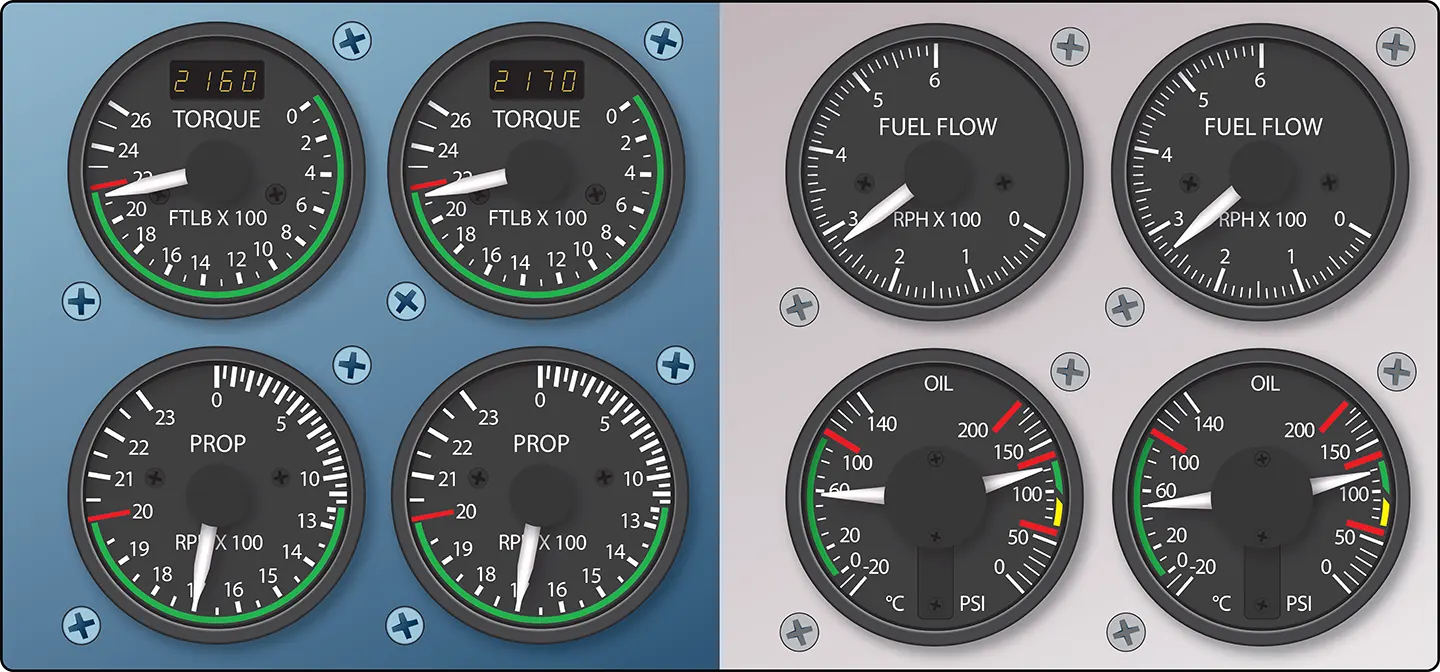
Turboprop engines use the normal instruments, including oil pressure, oil temperature, inter-turbine temperature (ITT), and fuel flow.
They also use instruments to measure gas generator speed, propeller speed, and the torque produced by the propeller. [Figure 1]
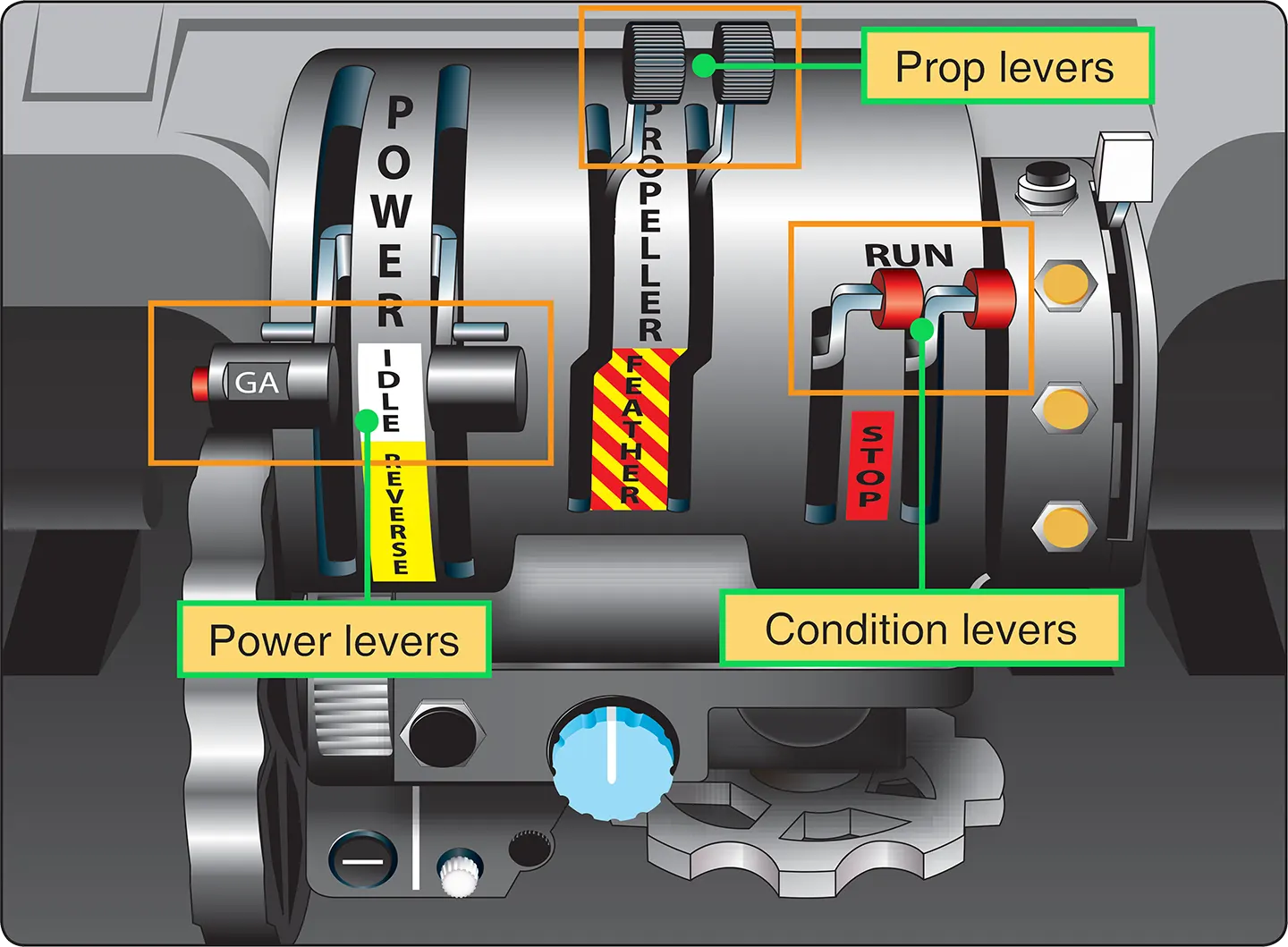
A typical turboprop uses a set of engine controls, such as power levers (throttles), propeller levers, and condition levers. [Figure 2]
Turboprop Engine Starting Systems
The first step in starting a turbine engine is to provide an adequate source of power for the starter.
On smaller turbine engines, the starter may be an electric motor that turns the engine using electrical power.
Larger engines require a more powerful starter. Electric motors may be limited by current requirements and weight. Air-turbine starters were developed because they are relatively lightweight and can produce sufficient power to turn the engine at the correct starting speed.
When an air-turbine starter is used, the starting air supply may be obtained from an onboard APU, an external source (ground air cart), or an engine cross-bleed operation.
In some limited cases, a low-pressure, large-volume tank can provide the air required to start an engine.
Many smaller turboprop engines use a starter/generator, which functions as both the engine starter and the electrical generator.
While starting an engine, always observe the following:
- Observe the starter duty cycle. Otherwise, the starter can overheat and become damaged.
- Ensure that sufficient air pressure or electrical capacity is available before attempting a start.
- Do not perform a ground start if the turbine inlet temperature (residual temperature) exceeds the limit specified by the manufacturer.
- Provide fuel at the required low pressure to the engine-driven fuel pump.
Turboprop Starting Procedures
To start an engine on the ground, the following operations illustrate a typical starting sequence:
- Turn the aircraft boost pumps ON.
- Make sure that the power lever is in the “START” position.
- Place the start switch in the “START” position. This starts the engine turning.
- Turn the ignition switch ON. On some engines, the ignition is activated by moving the fuel lever.
- Turn the fuel ON by moving the condition lever to the “ON” position.
- Monitor the engine exhaust temperature indication. If it exceeds the specified limits, shut the engine down.
- Check the oil pressure and temperature.
- After the engine reaches a self-sustaining speed, the starter is disengaged.
- The engine continues to accelerate to idle speed.
- Maintain the power lever in the “START” position until the specified minimum oil temperature is reached, where required.
- Disconnect the ground power supply, if used.
Note: These control positions and the sequence are specific to the type of engine described. The actual engine-starting procedure must follow the applicable manufacturer’s instructions.
Unsatisfactory Turboprop Starts
If any of the following conditions occur during the starting sequence, turn off the fuel and ignition switch, discontinue the start immediately, investigate the cause, and record the findings:
- Turbine inlet temperature exceeds the specified maximum. Record the observed peak temperature.
- Acceleration time from the start of propeller rotation to stabilized rpm exceeds the specified time.
- There is no oil pressure indication at 5,000 rpm for either the reduction gear or the power unit, where this limit applies to the engine.
- Torching occurs, indicated by visible burning in the exhaust nozzle.
- The engine fails to ignite by 4,500 rpm or maximum motoring rpm, where these limits apply.
- Abnormal vibration occurs or compressor surge is detected, possibly indicated by backfiring.
- The fire warning bell rings. This may indicate an engine fire or overheat condition.
The rpm values listed above are examples for a particular engine arrangement and must not be applied to other engines without verifying the manufacturer’s specifications.
Turbofan Engines
Unlike reciprocating-engine aircraft, turbine-powered aircraft generally do not require a preflight engine run-up unless it is necessary to investigate a suspected malfunction or is required by an approved procedure.
Before starting, remove all protective covers and air inlet duct covers.
If possible, position the aircraft into the wind to obtain better cooling, faster starting, and smoother engine performance.
It is especially important that the aircraft be headed into the wind if the engine is to be trimmed, where specified by the manufacturer.
The run-up area around the aircraft must be cleared of personnel and loose equipment.
The turbofan engine intake and exhaust hazard areas are illustrated in Figure 3.
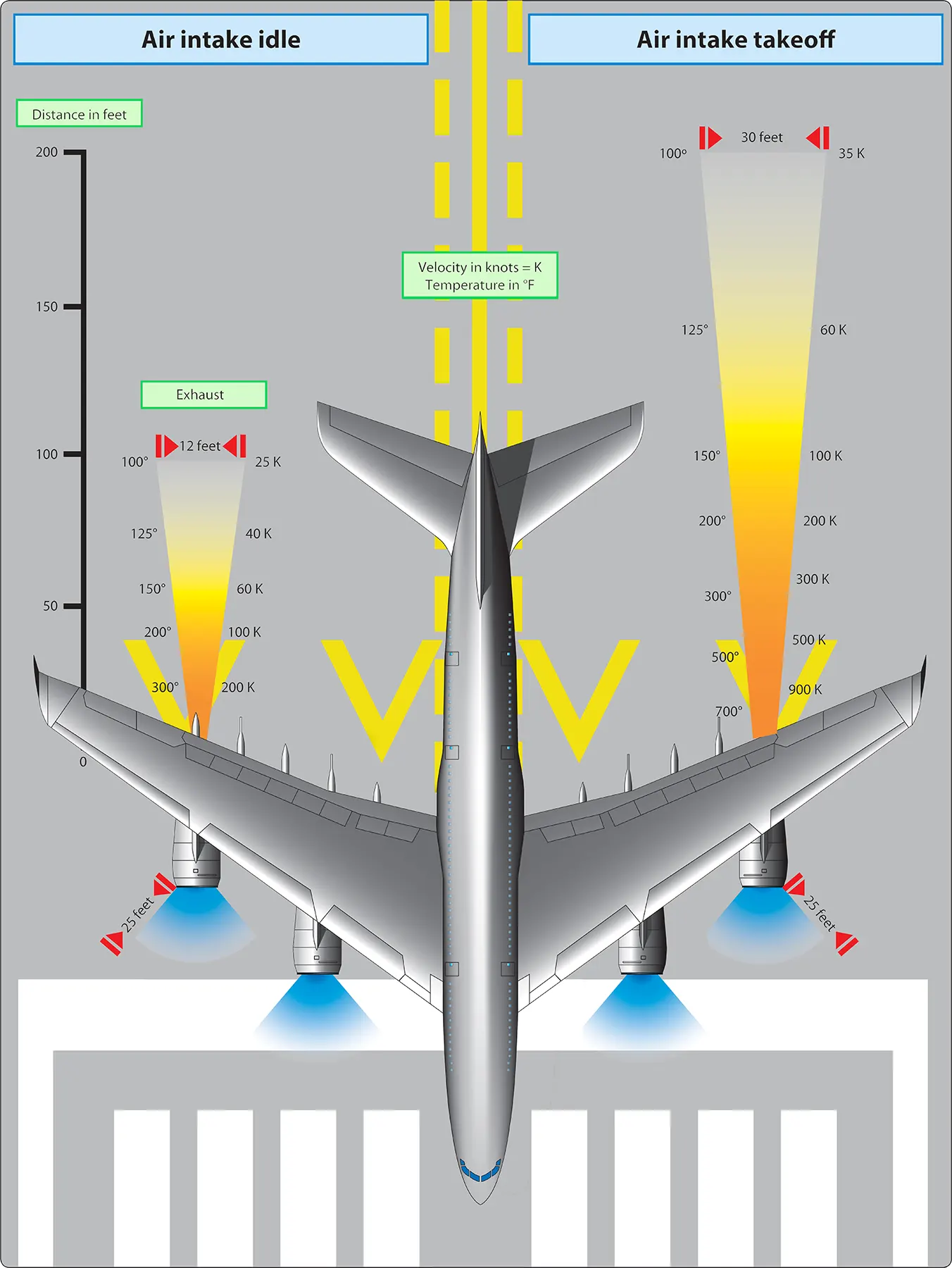
Exercise care to ensure that the run-up area is free of items such as nuts, bolts, rocks, shop towels, and other loose debris.
Many serious accidents have occurred involving personnel near turbine engine air inlets. Use extreme caution when starting turbine-powered aircraft.
Check the aircraft fuel sumps for water or ice. Inspect the engine air inlet for general condition and the presence of foreign objects.
Visually inspect the fan blades, forward compressor blades, and compressor inlet guide vanes for nicks and other damage.
If permitted by the manufacturer, check the fan blades for free rotation using the approved inspection procedure.
All engine controls must be operational. Check the engine instruments and warning lights for proper operation.
Starting a Turbofan Engine
The following procedures are typical of those used to start many turbine engines. However, there are wide variations in the starting procedures used for different turbine engines.
Do not attempt to use these procedures for actually starting an engine. They are presented only as a general guide for familiarization with typical procedures and methods.
For starting all turbine engines, refer to the detailed procedures contained in the applicable manufacturer’s instructions or their approved equivalent.
Most turbofan engines can be started using either air-turbine or electrical starters.
Air-turbine starters use compressed air from an external source or an onboard air supply, as discussed earlier.
Fuel is turned on either by moving the start lever to the “IDLE/START” position or by opening a fuel shutoff valve.
If an air-turbine starter is used, the engine should light off within a predetermined time after the fuel is turned on.
If this time interval is exceeded, a malfunction has occurred, and the start must be discontinued.
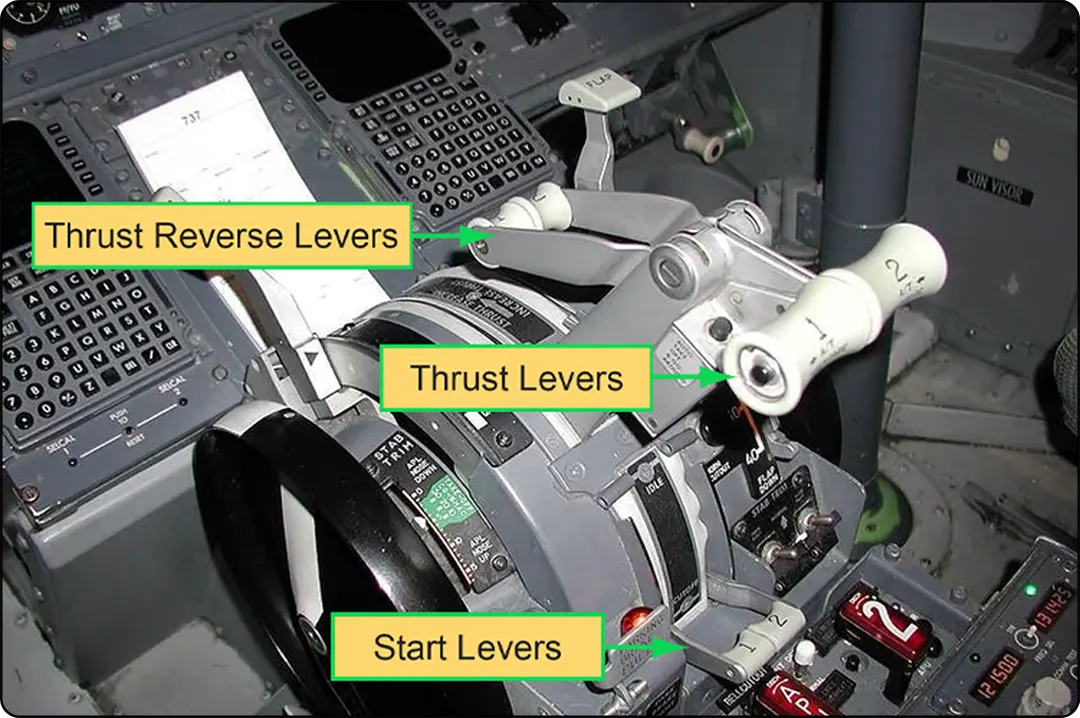
Most turbofan engine controls consist of a power lever, thrust-reverser levers, and start levers. Newer aircraft may use a fuel switch instead of conventional start levers. [Figure 4]
Turbofan engines also use normal engine instruments, including engine speed indicators (percent of total rpm), exhaust gas temperature, fuel flow, oil pressure, and oil temperature.
An instrument used to indicate the amount of thrust being produced on certain engines is the engine pressure ratio (EPR).
EPR is the ratio of total pressure at the engine exhaust or turbine discharge to total pressure at the engine inlet.
The following procedures are useful only as a general guide and are included to show the sequence of events when starting a turbofan engine.
- If the engine is so equipped, place the power lever in the “IDLE” position.
- Turn the fuel boost pump switch or switches ON.
- Check the fuel inlet pressure indicator to ensure that fuel is being delivered to the engine fuel pump inlet.
- Turn the engine starter switch ON. Note that the engine rotates to a preset speed. Check for oil pressure.
- Turn the ignition switch ON. This is usually accomplished by moving the start lever toward the “ON” position. A microswitch connected to the lever turns on the ignition.
- Move the start lever to the “IDLE” or “START” position. This starts fuel flow into the engine.
- Engine light-off is indicated by a rise in exhaust gas temperature.
- If the engine is a two-spool engine, check the rotation of the fan or N1.
- Check for proper oil pressure.
- Turn the engine starter switch OFF at the proper speed.
- After the engine stabilizes at idle, ensure that none of the engine operating limits are exceeded.
- On newer aircraft, the starter disengages automatically.
Auxiliary Power Units (APUs)
Auxiliary power units are generally smaller turbine engines that provide compressed air for starting engines, cabin heating and cooling, and electrical power while the aircraft is on the ground.
Their operation is normally simple. By turning a switch ON and moving it to the START position (spring-loaded to the ON position), the engine starts automatically.
During starting, the exhaust gas temperature must be monitored.
On many APUs, the engine operates at 100 percent of its rated speed with no external load. This speed indication is installation-specific.
After the engine reaches its operating rpm, it can be used for cabin cooling or heating and for supplying electrical power.
An APU is also commonly used to start the aircraft’s main engines.
Unsatisfactory Turbine Engine Starts
Hot Start
A hot start occurs when the engine starts, but the exhaust gas temperature exceeds the specified limits.
This is usually caused by an excessively rich air-fuel mixture entering the combustion chamber.
The condition may result from too much fuel or insufficient airflow.
The fuel supply to the engine must be shut off immediately in accordance with the manufacturer’s procedure.
False or Hung Start
A hung start occurs when the engine lights off normally, but the rpm remains at a low value rather than increasing to normal starting or idle rpm.
This is often the result of insufficient power to the starter or the starter disengaging before the engine begins to accelerate independently.
A false start is generally associated with a starting attempt in which proper light-off is not achieved.
In either case, discontinue the start and shut down the engine according to the manufacturer’s instructions.
Engine Fails to Start
An engine may fail to start within the prescribed time limit because of:
- Lack of fuel supplied to the engine.
- Insufficient or no electrical power to the exciter in the ignition system.
- Incorrect fuel-air mixture.
If the engine fails to start within the prescribed time, shut it down according to the manufacturer’s instructions.
Precautions After an Unsatisfactory Start
In all cases of unsatisfactory starts, the fuel and ignition must be turned OFF.
A typical procedure calls for continuing to rotate the compressor for approximately 15 seconds to remove accumulated fuel from the engine.
If the engine cannot be motored (rotated), a 30-second fuel-draining period may be specified before another starting attempt.
These times are examples and must be verified against the applicable engine manufacturer’s instructions. The correct motoring, cooling, and fuel-draining procedures must always be followed before attempting another start.