
1. Which of the following fire detectors are commonly used in the power section of an engine nacelle?
- CO detectors.
- Smoke detectors.
- Rate-of-temperature-rise detectors.
2. What is the function of a fire detection system?
- To discharge the powerplant fire-extinguishing system at the origin of the fire.
- To activate a warning device in the event of a powerplant fire.
- To identify the location of a powerplant fire.
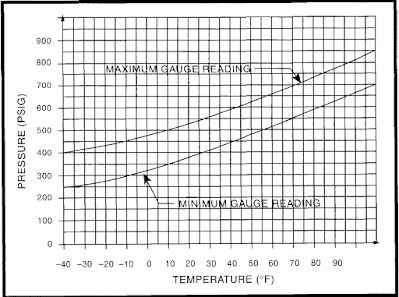
3. (Refer to figure 1) Determine the fire-extinguisher container pressure limits when the temperature is 750F.
- 326 minimum and 415 maximum.
- 330 minimum and 419 maximum.
- 338 minimum and 424 maximum.

4. How are most aircraft turbine engine fire-extinguishing systems activated?
- Electrically discharged cartridges.
- Manual remote control valve.
- Pushrod assembly.
5. How does carbon dioxide (C02) extinguish an aircraft engine fire?
- Contact with the air converts the liquid into snow and gas which smothers the flame.
- By lowering the temperature to a point where combustion will not take place.
- The high pressure spray lowers the temperature and blows out the fire.
6. What retains the nitrogen charge and fire-extinguishing agent in a high rate of discharge (HRD) container?
- Breakable disk and fusible disk.
- Pressure switch and check tee valve.
- Pressure gauge and cartridge.
7. A continuous-loop fire detector is what type of detector?
- Spot detector.
- Overheat detector.
- Rate-of-temperature-rise detector.
8. What is the operating principle of the spot detector sensor in a fire detection system?
- Resistant core material that prevents current flow at normal temperatures.
- A conventional thermocouple that produces a current flow.
- A bimetallic thermoswitch that closes when heated to a high temperature.
9. How is the fire-extinguishing agent distributed in the engine section?
- Spray nozzles and fluid pumps.
- Nitrogen pressure and slinger rings.
- Spray nozzles and perforated tubing.
10. Which of the following is the safest fire-extinguishing agent to use from a standpoint of toxicity and corrosion hazards?
- Dibromodifluoromethane (Halon 1202).
- Bromochlorodifluoromethane (Halon 1211).
- Bromotrifluoromethane (Halon 1301).
11. Which of the following is NOT used to detect fires in reciprocating engine nacelles?
- Smoke detectors.
- Rate-of-temperature-rise detectors.
- Flame detectors.
12. What is the principle of operation of the continuous-loop fire detector system sensor?
- Fuse material which melts at high temperatures.
- Core resistance material which prevents current flow at normal temperatures.
- A bimetallic thermoswitch which closes when heated to a high temperature.
13. The most satisfactory extinguishing agent for a carburetor or intake fire is
- carbon dioxide.
- dry chemical.
- methyl bromide.
14. The explosive cartridge in the discharge valve of a fire extinguisher container is
- a life-dated unit.
- not a life-dated unit.
- mechanically fired.
15. Why does one type of Fenwal fire detection system use spot detectors wired in parallel between two separate circuits?
- To provide an installation that is equal to two separate systems: a primary system and a secondary, or back-up system.
- So that a double fault may exist in the system without sounding a false alarm.
- So that a single fault may exist in the system without sounding a false alarm.
16. Which of the following fire detection systems measures temperature rise compared to a reference temperature?
- Thermocouple.
- Thermal switch.
- Lindberg continuous element.
17. The pulling out (or down) of an illuminated fire handle in a typical large jet aircraft fire protection system commonly accomplishes what events?
- Closes all firewall shutoff valves, disconnects the generator, and discharges a fire bottle.
- Closes fuel shutoff, closes hydraulic shutoff, disconnects the generator field, and arms the fire extinguishing system.
- Closes fuel shutoff, closes hydraulic shutoff, closes the oxygen shutoff, disconnects the generator field, and arms the fire-extinguishing system.
18. A fire detection system operates on the principle of a buildup of gas pressure within a tube proportional to temperature. Which of the following systems does this statement define?
- Kidde continuous-loop system.
- Lindberg continuous-element system.
- Thermal switch system.
19. The fire detection system that uses a single wire surrounded by a continuous string of ceramic beads in a tube is the
- Fenwal system.
- Kidde system.
- thermocouple system.
20. The fire detection system that uses two wires imbedded in a ceramic core within a tube is the
- Fenwal system.
- Lindberg system.
- Kidde system.
21. A fuel or oil fire is defined as a
- class B fire.
- class A fire.
- class C fire.
22. A fire detection system that operates on the rate-of temperature rise is a
- continuous-loop system.
- thermocouple system.
- thermal switch system.
23. A fire involving energized electrical equipment is defined as a
- class B fire.
- class D fire.
- class C fire.
24. Two continuous-loop fire detection systems that will not test due to a broken detector element are the
- Kidde system and the Lindberg system.
- Kidde system and the Fenwal system.
- thermocouple system and the Lindberg system.
25. In a fixed fire-extinguishing system, there are two small lines running from the system and exiting overboard. These line exit ports are covered with a blowout type indicator disc. Which of the following statements is true?
- When the red indicator disc is missing, it indicates the fire-extinguishing system has been normally discharged.
- When the yellow indicator disc is missing, it indicates the fire-extinguishing system has been normally discharged.
- When the green indicator disc is missing, it indicates the fire-extinguishing system has had a thermal discharge.
26. The most satisfactory extinguishing agent for an electrical fire is
- carbon tetrachloride.
- carbon dioxide.
- methyl bromide.
27. Which of the following fire detection systems will detect a fire when an element is inoperative but will not test when the test circuit is energized?
- The Kidde system and the thermocouple system.
- The Kidde system and the Fenwal system.
- The thermocouple system and the Lindberg system.
28. Which of the following fire detection systems uses heat in the normal testing of the system?
- The thermocouple system and the Lindberg system.
- The Kidde system and the Fenwal system.
- The thermocouple system and the Fenwal system.
29. After a fire is extinguished, or overheat condition removed in aircraft equipped with a Systron-Donner fire detector, the detection system
- must be manually reset.
- automatically resets.
- sensing component must be replaced.
30. The use of water on class D fires
- is most effective if sprayed in a fine mist.
- will cause the fire to burn more violently and can cause explosions.
- has no effect.
31. For fire detection and extinguishing purposes, aircraft powerplant areas are divided into fire zones based on
- hot and cold sections of the engine.
- the volume and smoothness of the airflow through engine compartments.
- engine type and size.
32. (Refer to figure 2) What are the fire-extinguisher container pressure limits when the temperature is 50 0F?
- 425 – 575 PSIG
- 435 – 605 PSIG
- 475 – 625 PSIG.

| Join our community on Patreon to access our full library of AMT study resources. Join Patreon Get Fillable PDF |