
When two dissimilar metals are placed in contact in the presence of moisture, galvanic corrosion can occur due to differences in their electrical potential. This condition is commonly referred to as dissimilar metal corrosion. The presence of an electrolyte, particularly salt water, accelerates the galvanic action. As a result, one of the metals undergoes oxidation (decomposition), leading to corrosion.
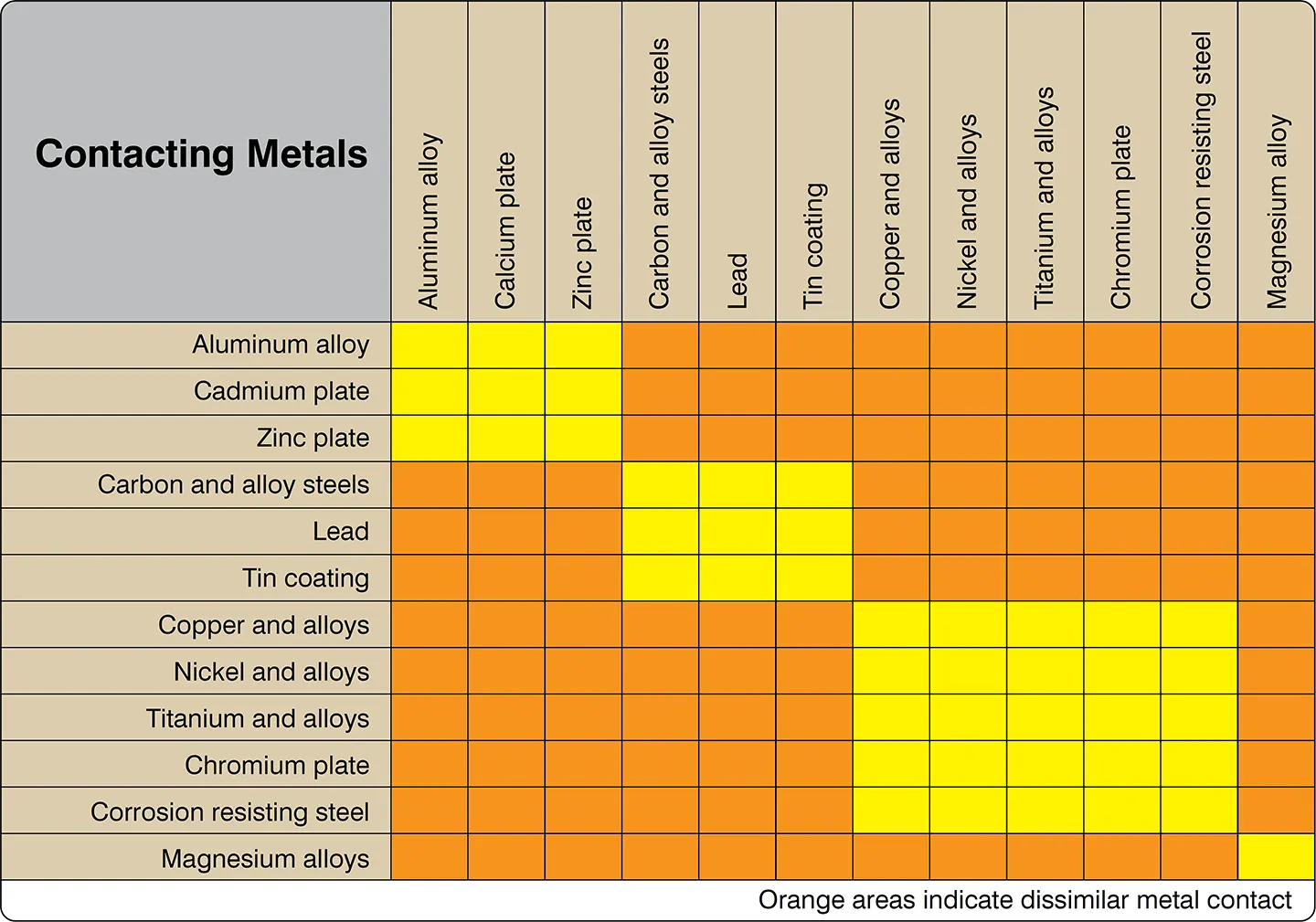 |
| Dissimilar metal contacts that will result in electrolytic corrosion |
The chart shown in Figure identifies metal combinations that require protective separation. To prevent direct metal-to-metal contact, suitable separating materials such as metal primer, aluminum tape, washers, grease, or sealant are used, depending on the specific metals involved.
Quick Comparison: The table below highlights key differences in protection methods.
| Aspect | Contacts Not Involving Magnesium | Contacts Involving Magnesium |
|---|---|---|
| Corrosion Risk | Moderate galvanic corrosion risk | High corrosion risk (magnesium is highly anodic) |
| Primary Protection Method | Minimum two coats of primer | Primer + additional insulation required |
| Recommended Primer | Zinc chromate or epoxy primer | Zinc chromate or epoxy primer (mandatory) |
| Number of Coats | Minimum 2 coats | Minimum 2 coats (3 if no tape used) |
| Additional Insulation | Usually not required | Pressure-sensitive vinyl tape (0.003″) |
| Tape Usage | Optional | Required unless conditions prevent use |
| When Tape is NOT Used | Not applicable | High temperature (>250°F), movement between parts, or assembly interference |
| Alternative to Tape | Not required | Apply minimum 3 coats of primer |
| Application Notes | Allow ~6 hours drying between coats | Do not stretch tape; avoid bubbles and wrinkles |
| Overall Protection Level | Standard protection | Enhanced protection required |
Contacts Not Involving Magnesium
All dissimilar metal joints not involving magnesium are protected by applying a minimum of two coats of zinc chromate primer or, preferably, epoxy primer, in addition to normal primer requirements. The primer may be applied by brush or spray and should be allowed to air dry for approximately 6 hours between coats to ensure proper curing and effectiveness.
Contacts Involving Magnesium
Magnesium alloys are highly susceptible to galvanic corrosion and require additional protection when used in contact with dissimilar metals. To prevent corrosion in such joints, each surface is insulated using the following procedure:
At least two coats of zinc chromate or, preferably, epoxy primer are applied to each surface. After the primer has dried, a layer of pressure-sensitive vinyl tape, approximately 0.003 inch thick, is applied smoothly and firmly to prevent air bubbles and wrinkles. The tape should not be stretched during application to avoid creep back.
In cases where the thickness of the tape interferes with proper assembly, where relative motion exists between parts, or where service temperatures above 250 °F are expected, the use of tape is not recommended. Instead, additional primer coats (a minimum of three) should be applied to provide adequate protection.
- Operating temperature exceeds 250°F.
- There is relative motion (rubbing) between parts.
- Tape thickness prevents proper fit/alignment during assembly.
In these cases, use a minimum of 3 coats of primer.